How Gold Tokenization Works: An End-to-End RWA Use Case
Learn how gold tokenization works - from product structuring and custody to minting, distribution, trading, reserve verification and...
Learn how gold tokenization works - from product structuring and custody to minting, distribution, trading, reserve verification and...
In our previous article, we introduced the end-to-end RWA tokenization lifecycle – from defining the product and establishing its legal structure to issuing tokens, managing the underlying asset and enabling redemption. This article applies that framework to a specific use case: tokenized gold.
Gold is a familiar physical asset, yet tokenizing it requires much more than simply creating a digital token. The goal is to make gold easier to access, divide, transfer and integrate with digital financial applications – while supporting more efficient settlement and programmable lifecycle operations and preserving a verifiable link to the underlying physical gold.
This article follows a hypothetical gold-backed product – from its initial design by a financial institution to token issuance, onchain use and eventual redemption – to illustrate the full RWA tokenization lifecycle.
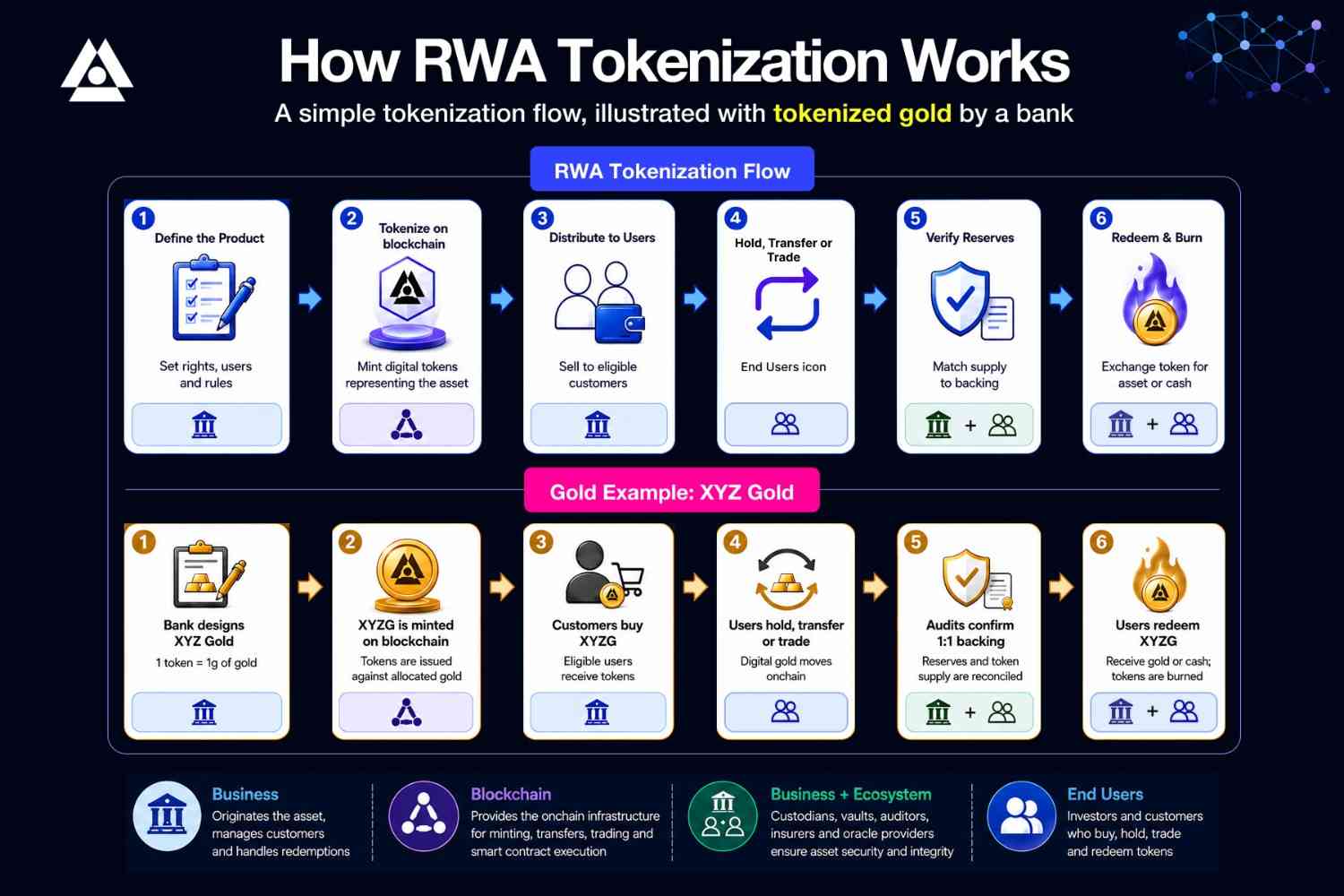
Consider a bank that decides to offer XYZ Gold (XYZG), a tokenized gold product for its KYC-verified customers.
The bank defines XYZ Gold, procures the gold and establishes its terms.
The bank deploys XYZG on a blockchain and mints tokens against allocated gold.
Eligible customers purchase XYZG and receive the tokens in approved wallets or bank-managed accounts.
Customers use approved wallets and marketplaces.
The issuer reconciles circulating XYZG against custodian records, supported by periodic independent reserve verification.
Customers redeem XYZG, and the corresponding tokens are removed from circulation.
The bank would typically define the following:
To establish the backing, the bank would work with approved bullion dealers, assayers, custodians and vault operators to:
20 kilograms of eligible physical gold
                 ↓
Maximum issuance of 20,000 XYZG
The bank selects a blockchain network and deploys audited smart contracts for XYZG on the network.
Once the custodian confirms that eligible gold has been received and allocated, the bank authorizes an equivalent quantity of XYZG to be minted on the blockchain network.
20 kilograms of eligible physical gold
                ↓
20,000 XYZG minted on the selected blockchain
A. Token creation and destruction
B. Digital ownership records:
Private keys authorize transactions from self-custodied wallets. The bank may also offer custodial wallets in which it securely manages access on behalf of customers.
The blockchain records token balances and transfers. The product terms establish the holder’s legal rights over the corresponding gold.
C. Programmable product rules via smart contracts can:
These controls depend on identity, sanctions and eligibility systems supplying accurate and current information to the onchain contracts.
D. Transparent transaction history
A blockchain explorer or bank dashboard can display:
Customer names, KYC documents and other sensitive personal information should generally remain offchain, while the blockchain records only the eligibility status, attestations or references required to enforce the product’s rules.
E. Fast, low-Cost settlement
XYZG transfers can achieve fast onchain finality with low network fees. When integrated with custody, banking and payment infrastructure, the broader settlement process can also become significantly more efficient, while maintaining compatibility with existing financial systems.
F. Application integrations
XYZG can potentially integrate with approved:
These integrations can extend XYZG beyond holding and trading. Subject to the product’s legal terms, eligible holders could use XYZG in approved lending, collateral or professionally managed onchain strategies. Such activities would be optional and would introduce additional utility and risks beyond those associated with holding the standard gold-backed token.
The bank offers XYZG through its banking application, investment platform or approved distribution partners.
Customer journey
Customer purchases 5 grams of tokenized gold
                 ↓
5 XYZG transferred to the customer
                 ↓
Customer balance: 5 XYZG
Depending on the product’s permitted features, customers may:
Secondary-market transaction
Buyer submits payment
        ⇄
Seller transfers XYZG
        ↓
The blockchain records the XYZG transfer and any payment leg that also settles onchain.
If payment occurs through fiat or another offchain system, the payment and token-transfer legs must be coordinated and reconciled across the relevant systems. Also note, depending on market liquidity, demand, spreads, fees and redemption conditions, XYZG may trade above or below the reference value of its underlying gold.
Ongoing reserve assurance typically involves several participants:
The blockchain shows token supply and minting and burning activity, while the custodian, issuer and independent assurance provider establish whether the reported offchain gold reserves correspond to the circulating token supply.
Core rule: Eligible fine gold held for the product ≥ Fine gold represented by circulating XYZG
Customers can redeem XYZG according to the product’s terms.
Cash or stablecoin redemption
Physical-gold redemption
5 XYZG redeemed and burned
            ↓
Customer receives 5 grams of gold or its permitted cash equivalent
            ↓
Circulating XYZG supply decreases by 5
On EVM-compatible networks such as Shardeum, issuers can use ERC-20 as the base interface for a fungible token and combine it with additional components for metadata, identity, compliance, transfer controls, pricing, reserve data and application integrations. Together with smart contracts, familiar EVM tooling and established developer workflows, this provides a flexible foundation for building tokenized asset products.
While this article focused on gold, the same principles apply across a wide range of real-world assets – including government securities, private credit, commodities, real estate, investment funds and intellectual property. It is important to note that RWA tokenization may involve multiple specialized participants, much like modern financial and digital services today. The opportunity is to connect them through standardized, programmable infrastructure and automated workflows, so complexity remains behind the scenes while the user experience stays simple.
Learn how real-world assets move from legal structuring and custody to token issuance, settlement, servicing and...
Explore how RWA tokenization connects real-world assets to blockchain infrastructure for faster settlement, broader access, and programmable...
Crust offers an open protocol where providers can earn rewards by contributing storage resources while users can access it for a nominal...